South Korea is celebrated worldwide as one of the most technologically advanced, virtually cashless societies on the planet. From neighborhood convenience stores and street cafes to unattended photo booths, locals tap credit cards or mobile phones for virtually every transaction.
However, paying in korea as a tourist can quickly turn frustrating if you rely entirely on your domestic habits. Foreign Visa or Mastercard chips occasionally get declined at local terminal kiosks, Apple Pay remains limited, Google Pay is virtually non-existent, and public subways still require cold hard cash to recharge physical transit cards.
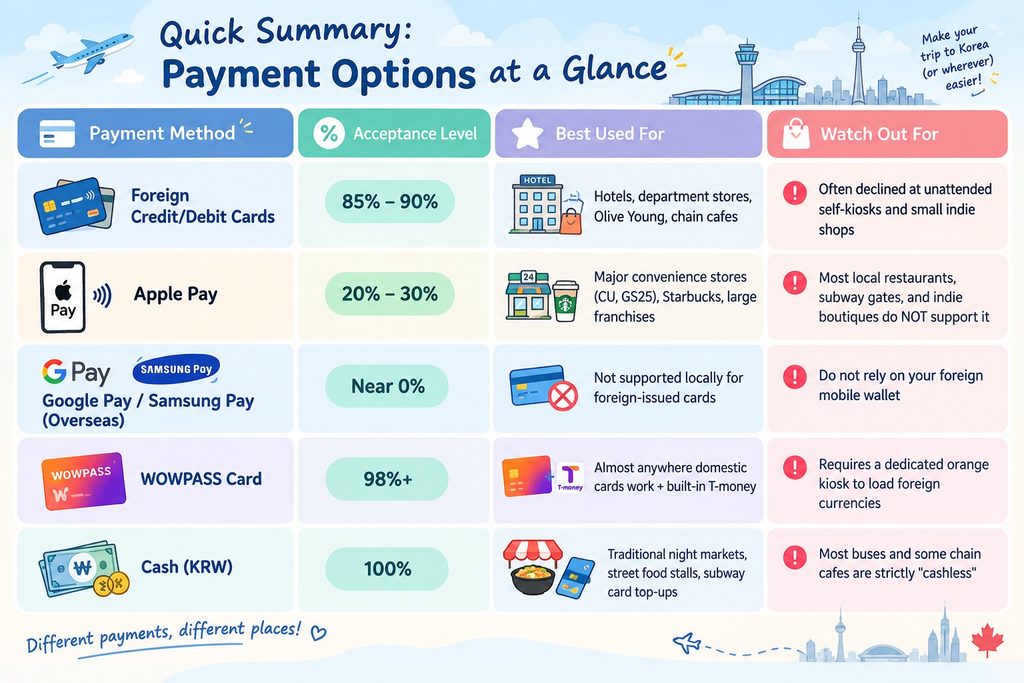
Quick Summary: Payment Options at a Glance
1. Can You Use Foreign Credit and Debit Cards in Korea?
Yes, but with caveats.
Major international credit cards (Visa and Mastercard) are widely accepted across tourist hotspots like Myeongdong, Hongdae, and Gangnam. American Express and Discover are accepted at luxury hotels and department stores, but smaller merchants frequently decline them due to higher processing fees.
The “Unattended Kiosk” Problem
Korea’s dining scene heavily relies on touchscreen self-ordering kiosks. Many localized kiosk systems are hardcoded to process domestic Korean bank networks (like BC Card or Shinhan). When inserting a foreign chip card, foreign travelers frequently encounter transaction errors.
Pro Tip: Always carry at least one backup payment method (a physical prepaid card like WOWPASS or emergency cash) when dining at self-service kiosks. Also, notify your home bank that you are traveling to South Korea to prevent automatic anti-fraud freezes.
2. Does Apple Pay or Google Pay Work in Korea?
- Apple Pay: Works only at selet international brands and major convenience store chains (such as CU, GS25, 7-Eleven, Mcdonald’s, and Starbucks. Korea’s payment infrastructure historically runs on MST and IC chip readers, meaning NFC-based terminals compatible with overseas Apple Pay are still limited in mom-and-pop shopss.
- Google Pay: Foreign Google Pay is not supported at standard Korean payment terminals.
- Transit Gates: You cannot tap your phone (Apple Pay or Google Pay) at subway turnstiles or on city buses using a foreign credit card. Public transport requires a physical IC chip transit card.
3. WOWPASS vs T-money: What’s the Real Difference?
If you want the conveniece of swiping like a local without worrying about foreign card declines or currency exchange fees, the WOWPASS card has become the go-to solution for international tourists.
What is WOWPASS?
WOWPASS is an all-in-one foreign currency prepaid card and T-money card designated exclusively for overseas travelers.
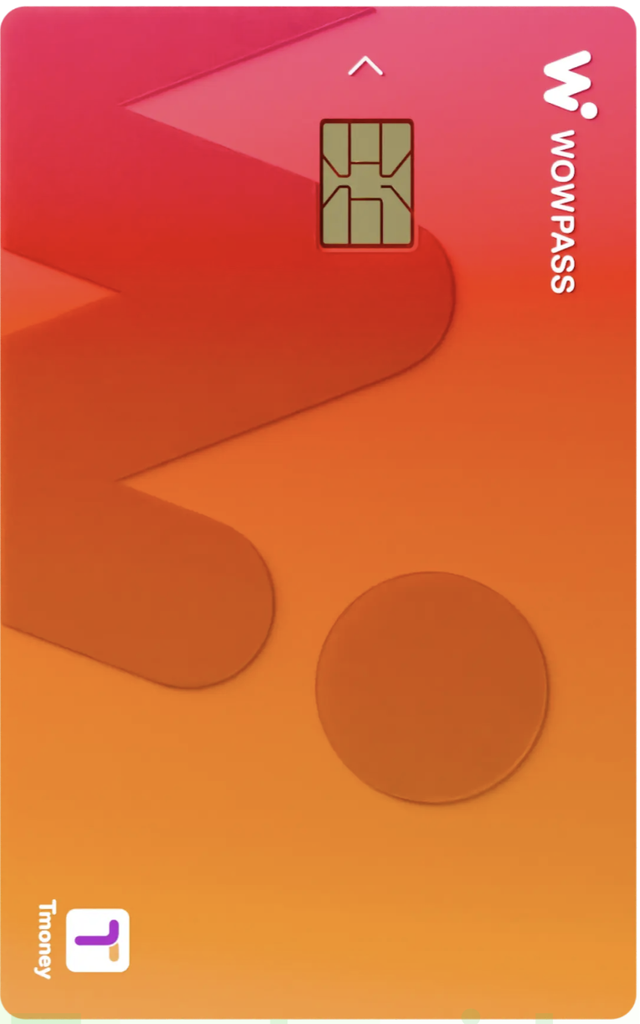
- How it works: You insert your home currency (USD, EUR, JPY, CAD, GBP, SGD, etc.) directly into anautomated orange WOWPASS kiosk (located across Incheon Airport, major subway stations, and hotel lobbies). The machine converts it to Korean Won (KRW) at competitive rates and dispenses a physical debit card.
- Accepted Everywhere: Because WOWPASS runs on the local Korean debit network, it works effortlessly at self-service kiosks, taxi meters, restaurants, and shopping spots where foreign Visa/Mastercards fail.
- Mobile App Integration: Link the card to the WOWPASS mobile app to track your spending in real time, view remaining balances, and receive instant cash-back rewards at partner stores.
For more information about WOWPASS, Please refer to https://www.wowpass.io/en
The Crucial Catch: Two Separate Balances!
This is the #1 mistake travelers make: WOWPASS has two distinct, independent balances on one single card:
- Shopping Balance (Debit): Reloadable using foreign cash via the orange WOWPASS kioks or app. Used for shops, cafes, and restaurants.
- Transportation Balance (T-money): Powers subways, buses, and public transport. This balance must be reloaded separately with physical KRW cash at subway ticket vending machines or convenience store cash registers.
Need a deeper dive? Check out our step-by-step breakdown on https://hiddenspotkorea.com/the-ultimate-guide-to-koreas-t-money-card-buying-recharging-and-using-it-like-a-local/ to see exactly how to navigate transit reloading.
4. How Much Cash Do You Really Need in Korea?
While you do not need thick envelopes of paper money, traveling completely cash-free is impossible.
You Must Have Cash for:
- Recharging Transit Cards: Physical subway top-up machines only take Korean Won Paper notes (₩1,000, ₩5,000, ₩10,000, ₩50,000). They do not take credit cards.
- Traditional Street Markets: Stalls at Gwangjang Market, Namdaemun, or Myeongdong street stalls prefer cash or local account transfers. Some accept cards, but cash ensures smooth transactions.
- Coin Lockers & Luggage Storage: While newer subway lockers accept cards, older station lockers still run on ₩500 coins or ₩1,000 bills.
Recommended Budget Strategy:
- Upon Arrival at Incheon Airport: Withdraw or exchange approximately ₩50,000 to ₩100,000 (roughly $40–$75 USD) in cash per person for transit card reloading and street snacks.
- Use WOWPASS opr Foreign Cards: Put all large expenditures (hotels, shopping, sit-down dining, train tickets) on your card to avoid carrying heavy coins.
5. Finding an English-Friendly ATM (Global ATM)
Need to withdraw cash using your overseas debit card? Look specifically for machines labeled “Global ATM” inside subway stations or bank branches (Woori, Hana, Shinhan, KB Kookmin).
- Standard domestic ATMs will reject international magnetic stripes/chips.
- Select the “Foreign Card”/”English” option on the touchscreen before inserting your card.
- Choose “Checking Account” or “Savings Account.”
- Local ATM fees typically range from ₩3,500 to ₩5,000 per transaction, so withdraw larger amounts less frequently rather than small daily sums.
Final Verdict: The Smart Traveler’s Payment Setup
To travel through Seoul completely stress-free:
- Get an all-in-one card: Pick up a WOWPASS at the airport or your first subway station for general purchases.
- Keep ₩30,000–₩50,000 cash: Keep this dedicated to your T-money transit balance and tasty street bites.
- Carry one Primary Foreign Visa/Mastercard: Keep it handy for larger hotel deposits and duty-free shopping.
Traveling smoothly across Korea is all about having the right combination of tech and practical backup. For getting from the runway to your hotel after you land, make sure to read our direct navigation guide on https://hiddenspotkorea.com/how-to-get-from-incheon-airport-to-seoul/