When international travelers plan a trip to South Korea, the typical itinerary includes bustling Seoul shopping streets, Busan beaches, or the ancient royal tombs in Gyeongju. But whenever friends ask me where to experience Korea’s authentic spiritual serenity, my immediate answer is Magoksa Temple in Gongju (마곡사).
Located at the foot of Mount Taehwa in Chungcheongnam-do, Magoksa Temple Gongju is one of the seven historic mountain monasteris inscribed together as a UNESCO World Heritage site: Sansa, Buddhist Mountain Monasteries in Korea.

As a Korean local who regularly escapes the city noise of Seoul on weekends, I put together these 7 essential tips and insights for visiting Magoksa Temple Gongju-covering its rich history, unique architectural treasures, local culinary specialties, and exact transportation options.
1. Discover Why Magoksa Temple Gongju Is Korea’s Peaceful Hidden Gem
In Korea, travelers and poets have repeated a famous seasonal proverb for centuries:
“Chun-Magok, Chu-Gapsa” (춘마곡 추갑사)
“Spring belongs to Magoksa; Autumn belongs to Gapsa”
This saying originated because Magoksa Temple Gongju is spectacular in springtime when cherry blossoms, mountain azaleas, and fresh green buds transform the valley into a living landscape painting. However, visiting in any season reveals the temple’s signature feature: its intimate connection with water.
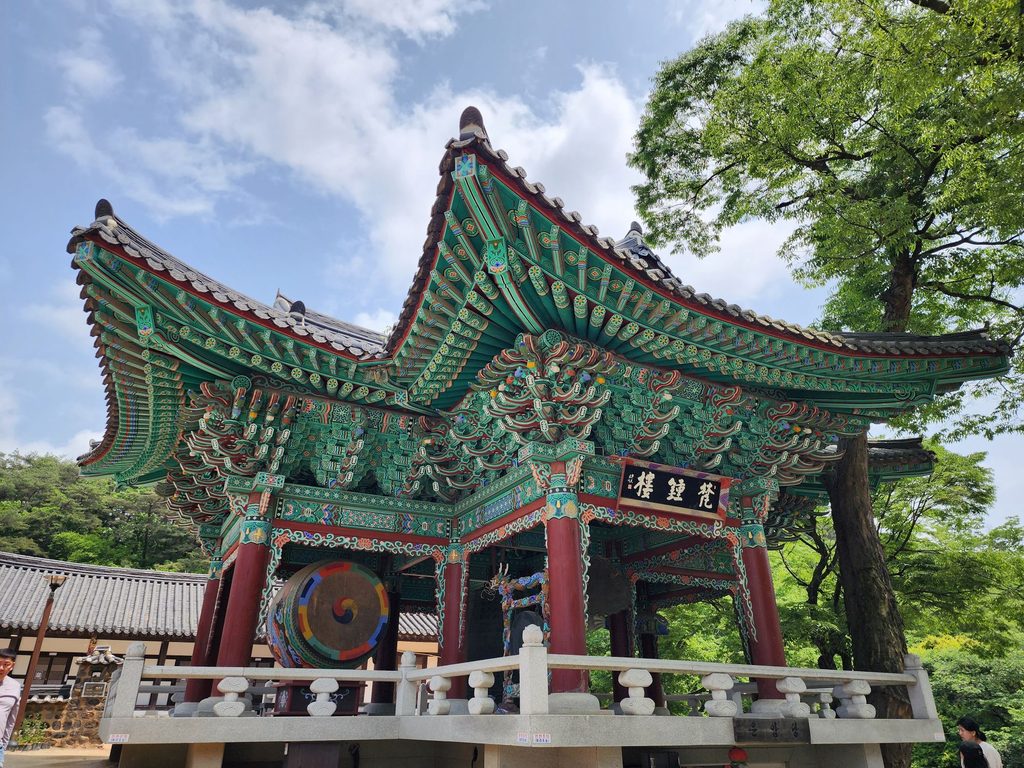
While many mountain monasteries in Korea are perched on steep, terraced cliffs, Magoksa Temple Gongju rests in a gentle valley cut by the Taehwacheon Stream. The river loops through the temple grounds in the exact curve of a traditional Taegeuk (the yin-and-yang symbol seen on the Korean national flag).
Crossing Geungnakgyo Bridge (극락교)-the Bridge of Paradise-decked with vibrant lotus lanterns, you leave behind daily worldly distractions as the soothing sound of flowinng mountain water welcomes you into sacred territory.
2. Embrace the Rare Two-Story Wooden Daeungbojeon Hall (대웅보전)
Most temple structures in South Korea are single-story buildings, but Magoksa’s Daeungbojeon (Treasure No. 801) is a rare two-story wooden pavilion preserved from the late Joseon Dynasty.
Notice the four colossal wooden pillars supporting the upper sanctuary floor. Local Korean folklore holds that wrapping both arms around one of these weathered timber pillars grants robust health and longevity. It is a heartwarming tradition shared by local elders and international visitors alike.

Standing proudly in the main courtyard before Daegwangbojeon Hall, the Five-Story Stone Pagoda (Treasure No. 199) features an extraordinary Tibetan Lamaist bronze finial (pungma) at its apex. Influenced by Yuan Dynasty Buddhist styles, this metal spire is an exceptional rarity among stone pagodas in Korea, serving as proof of historical maritime and cultural exchanges.
4. Walk in the Footsteps of Baekbeom Kim Koo on the Pine Meditation Trail
Magoksa Temple Gongju played a pivotal role in modern Korean history. In 1898, national independence hero Kim Koo (Baekbeom) escaped Japanese captivity following the Chihapo Incident and sought sanctuary at Magoksa.
Here, he shaved his head and took monastic vows under the Buddhist name Wonjong. Visitors can view the living quarters where he studied and the towering fragrant juniper tree he personally planted after Korea’s liberation in 1946. Just behind the complex lies the Baekbeom Meditation Trail (백범 명상길), an invigorating walking route shaded by aromatic pine trees.
5. Experience Evening Chanting & River Stone Stacking
During my recent visit, I arrived at Magoksa Temple Gongju in the late afternoon around 4:30 PM. As day-trip crowds began dispersing, the mountain air grew refreshingly cool, carrying the grounding aroma of pine resin, damp soil, and temple incense.
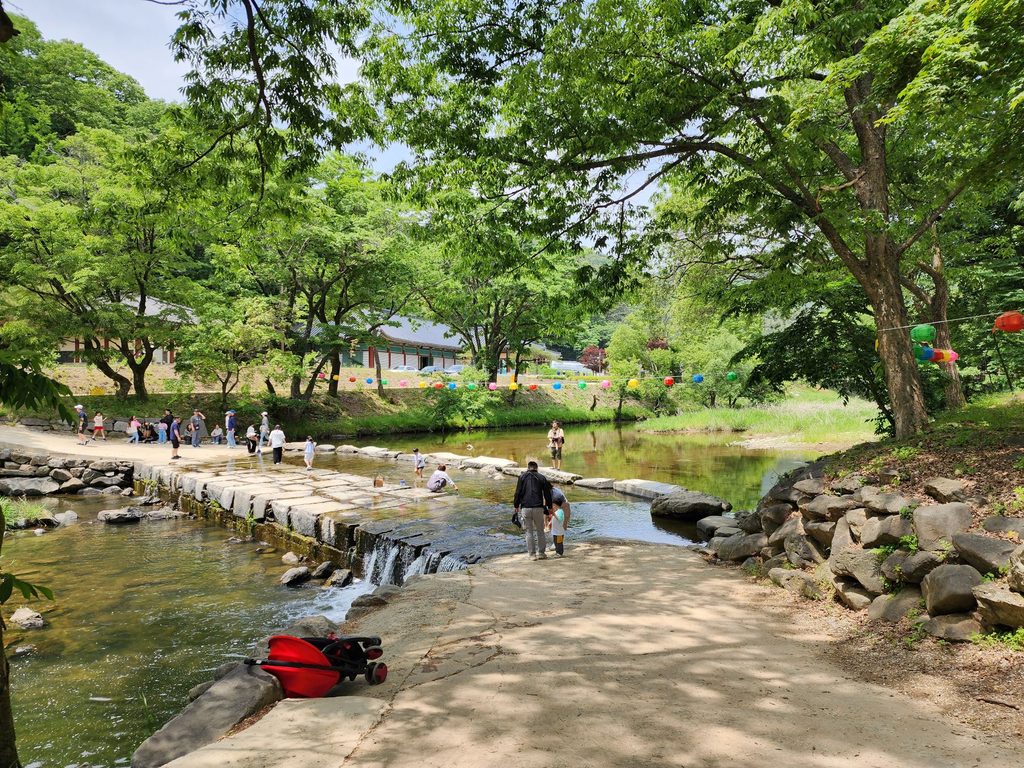
The quiet valley filled with the resonant rhythmic beat of the moktak (wooden fish gong) as monks began their evening chanting. Along the riverbank, visitors silently built small cairns—towers of stacked river stones—whispering heartfelt wishes for health and peace. Adding my own stone by the water’s edge reminded me why this temple remains such a special sanctuary for Koreans seeking headspace.
6. Savor Local Wild Greens & Gongju’s Famous Chestnuts
Just outside the temple entrance lies a lively village filled with traditional eateries. Make sure you do not leave without trying these regional delicacies:
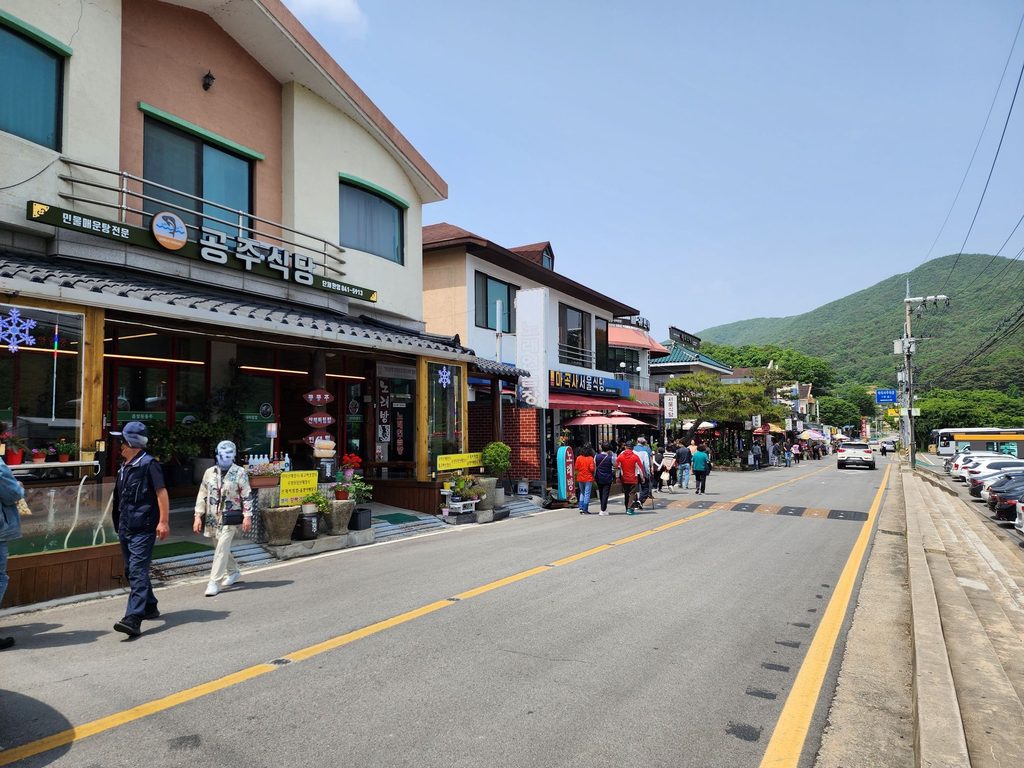
- Sanchae Bibimbap (산채비빔밥): A nourishing rice bowl topped with fresh mountain vegetables and wild herbs picked from surrounding peaks, accompanied by savory soybean paste stew (doenjang jjigae).
- Haemul Pajeon (해물파전): Crispy scallion and seafood pancake, made even better when shared with friends.
- Gongju Chestnuts (공주 밤): Gongju is renowned across South Korea as the country’s chestnut capital. Vendors roast sweet local chestnuts over glowing coals directly along the path.
- Gongju Bam-ppang (공주 밤빵): Fluffy, freshly baked pastries stuffed with smooth sweet chestnut filling.
- Chestnut Makgeolli (밤막걸리): A subtly sweet, nutty Korean rice wine crafted with Gongju chestnuts.
For more information about Korean Restaurant rules, Please refer to https://hiddenspotkorea.com/korean-restaurant-survival-guide-7-rules/
7. Plan Seamless Transit: How to Get to Magoksa Temple Gongju from Seoul
Reaching Magoksa Temple Gongju from Seoul is straightforward using public transportation:
Step 1: Seoul to Gongju Bus Terminal (Recommended)
- Departure: Take an express bus from Seoul Express Bus Terminal (Express Bus Terminal Station, Lines 3, 7, 9) or Seoul Nambu Terminal.
- Travel Time: Approximately 1 hour and 30 minutes.
- Fare: ~9,000 to 13,000 KRW (buses run every 20–30 minutes).
(Note: While KTX/SRT trains run to Gongju Station in about 1 hour, Gongju KTX Station is located far south of town. Taking the express bus directly to Gongju Bus Terminal is faster and much more convenient for visiting Magoksa).
For more information about Seoul Express Bus Terminal, Please refer to https://www.exterminal.co.kr
Step 2: Gongju Bus Terminal to Magoksa Temple
- By Local Bus: Board City Bus 770 at the bus stop outside Gongju Bus Terminal. It goes directly to the Magoksa parking area in 40–50 minutes (fare: ~1,500 KRW, payable with T-Money).
- By Taxi: A taxi ride takes around 25 minutes and costs approximately 22,000–26,000 KRW—an ideal and budget-friendly choice if traveling in a group of two to four.
Admission & Practical Details
- Admission Fee: Free (national cultural property admission fees were removed in May 2023).
- Operating Hours: Open 365 days a year from sunrise to sunset (approx. 06:00 – 18:30).
- Temple Etiquette: Wear comfortable shoes for walking gravel paths, dress respectfully (covering shoulders and knees), take off shoes before stepping into wooden prayer halls, and maintain a quiet, respectful voice.